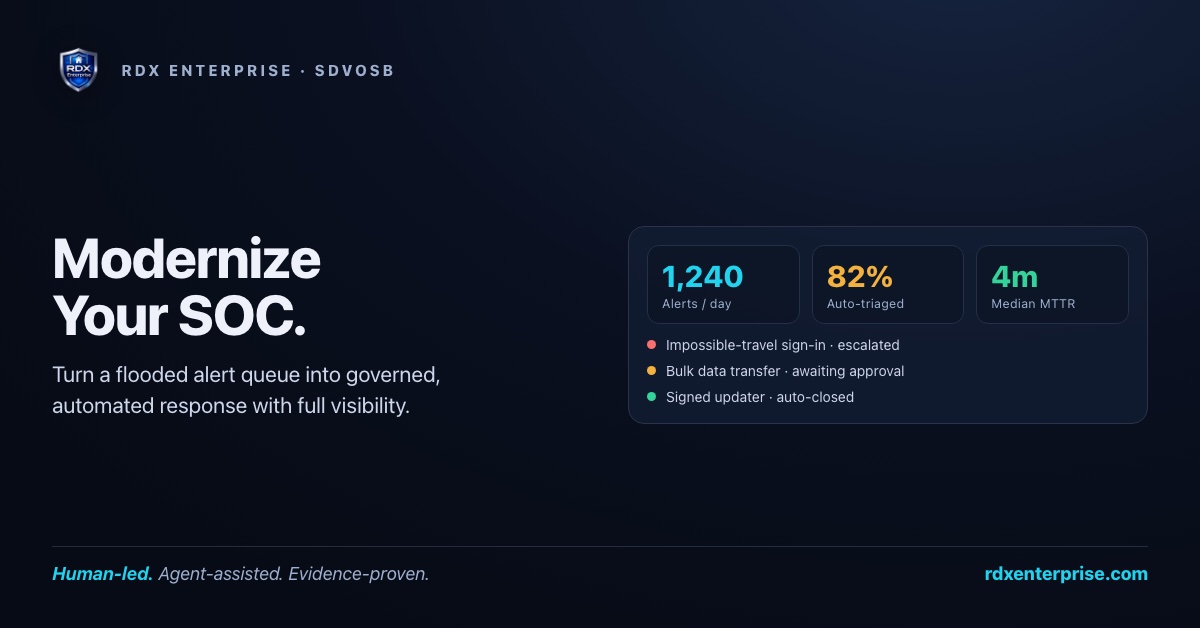
If you are evaluating SOAR implementation services, you already know the platform is only half the battle. Security orchestration, automation, and response (SOAR) tools deliver almost nothing out of the box. The value comes from the implementation: the integrations, the playbooks, and the human-in-the-loop design that turn a licensed platform into a working capability your analysts actually use. This article lays out what good SOAR implementation services include, the phases of a real engagement, the pitfalls to avoid, and how to tell a strong partner from a weak one.
Why implementation is where SOAR succeeds or fails
Most stalled SOAR projects did not fail because the platform was bad. They failed because someone bought the license, connected two tools, built a handful of demo playbooks, and then the momentum died. The playbooks did not match how the team actually worked, nobody trusted the automation, and it quietly fell out of use.
Good SOAR implementation services exist to prevent that. They start from your workflows, not the vendor’s demo, and they build automation your analysts will rely on because it fits the way they work and keeps them in control.
What a real SOAR implementation includes
A complete engagement covers more than “install and connect.”
Discovery and use-case selection. The work starts by mapping your current incident response processes and picking the highest-value, highest-volume workflows to automate first. Phishing triage, alert enrichment, and containment are common starting points because they eat analyst time and have clear steps.
Integration engineering. SOAR only works when it can talk to your stack: SIEM, EDR, email security, threat intelligence, identity, and ticketing. This is API work, and it is where experienced engineers earn their keep. Off-the-shelf integrations rarely cover every need, so custom connectors are part of the job.
Playbook development. The core deliverable. Each playbook decomposes a human process into clear, testable steps with the right decision points. A phishing playbook, for example, enriches the sender, detonates the attachment, identifies affected users, and stages containment, pausing for a human to approve the actions that matter.
Human-in-the-loop design. Strong implementations build approval gates into every consequential action. Routine low-risk steps run automatically; high-impact actions wait for a person. This is what makes automation safe to deploy and easy to trust.
Evidence and audit. Every automated step should be logged in a way that stands up to an audit. For regulated and government environments this is not optional. It is the difference between an automation you can defend and one you cannot.
Testing, tuning, and handoff. Playbooks get tested against real scenarios, tuned to cut false actions, versioned so they stay reliable, and handed off with documentation and training so your team can own them.
The phases of an engagement
A typical SOAR implementation runs in clear phases:
- Assess. Map processes, inventory tools, select the first use cases, and define what success looks like in measurable terms.
- Build. Engineer the integrations and develop the first set of playbooks with approval gates and evidence capture.
- Validate. Test against real incidents, measure time saved and accuracy, and tune.
- Deploy and train. Move to production, train the analysts who will supervise the automation, and document everything.
- Expand. Add use cases over time, so the capability grows instead of stalling after the first win.
The best partners treat this as building a capability you own, not creating a dependency on them.
Pitfalls to avoid
- Automating a process you have not mapped. Bad automation is worse than none. Map the human workflow first.
- Chasing full autonomy. Fully hands-off response sounds impressive and creates real risk. Keep a human on consequential actions.
- Skipping the evidence trail. If you cannot prove what your automation did, you will regret it during an audit or an incident review.
- One-and-done delivery. A partner who builds five playbooks and disappears leaves you with a capability nobody maintains. Look for training and handoff.
- Platform-first thinking. The platform matters less than the implementation. Do not let the license decide your outcome.
How to choose a SOAR implementation partner
Ask these questions:
- Have your engineers actually run enterprise SOAR migrations and built playbooks in production, or only in demos?
- How do you design human-in-the-loop approval and capture an audit trail?
- How do you handle custom integrations when the marketplace connector does not exist?
- What does handoff and training look like, so my team can own this?
- Can you support regulated or federal requirements if we need them?
You want depth and proof, not a slide deck.
How RDX approaches SOAR implementation
RDX Enterprise engineers SOAR implementations around one principle: control the action, prove the outcome. Our team has led enterprise Cortex XSOAR and Splunk SOAR migrations and built playbooks that drove large-scale incident response in production and federal environments. We start from your workflows, engineer the integrations your stack needs, and design human-in-the-loop approval and tamper-evident evidence into every playbook, so your analysts stay in command and your automation stands up to scrutiny. We build a capability your team owns, and we can support enterprise or federal requirements.
As an SBA-certified service-disabled veteran-owned firm, we bring the discipline of mission-driven security work to commercial and government clients alike.
To scope a SOAR implementation for your environment, request a consultation or explore our SOAR engineering and automation services.
Frequently asked questions
What do SOAR implementation services include? Discovery and use-case selection, integration engineering, playbook development, human-in-the-loop design, evidence and audit capture, and testing, tuning, training, and handoff.
How long does a SOAR implementation take? A focused first phase with a few high-value playbooks typically runs several weeks to a few months, depending on the number of integrations and the complexity of your environment. Capability then expands over time.
Which SOAR platforms do you implement? Cortex XSOAR and Splunk SOAR are the most common. The implementation approach and the value are similar across platforms, because the hard part is the integrations and playbook design, not the interface.
Can SOAR be implemented safely without full automation? Yes, and it should be. Strong implementations keep a human in the loop on consequential actions and automate the routine, high-volume work. That is how you get speed without giving up control.
Do you support federal or regulated environments? Yes. RDX builds the human-in-the-loop approval and tamper-evident evidence that regulated and government environments require, and we are an SBA-certified SDVOSB.