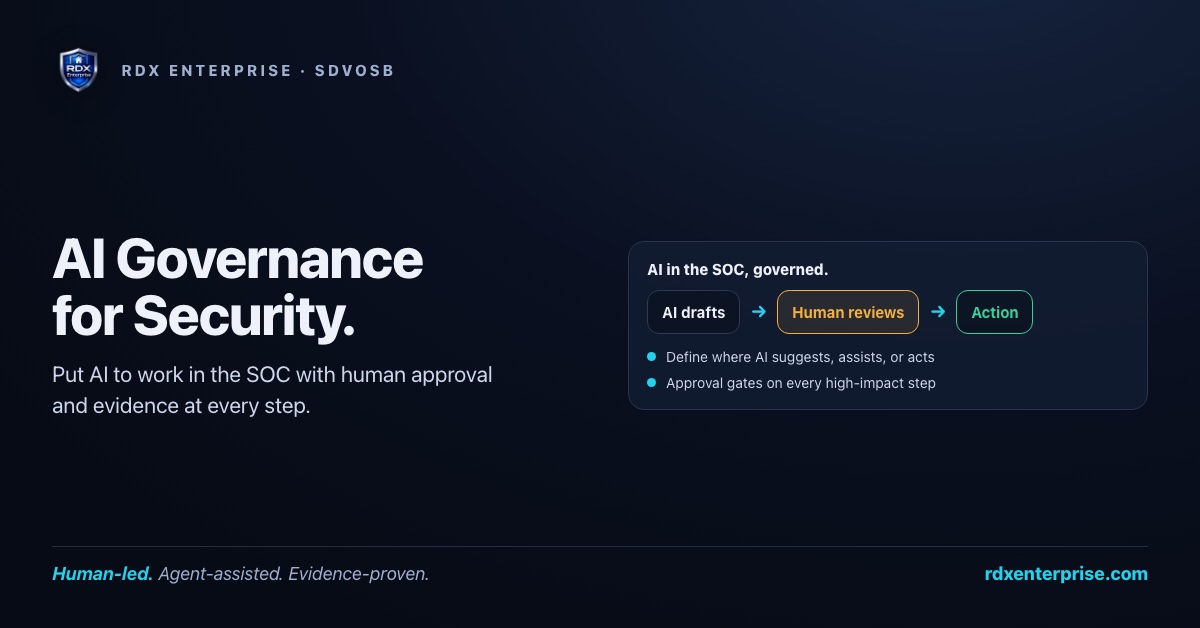
AI governance for security operations is the set of controls that let a security team use AI and automation without losing accountability for what happens on its network. As AI agents start to triage alerts, enrich incidents, and even take response actions, one question decides whether a security leader can actually deploy them: can you prove who approved each action, what the AI did, and that you can undo it if it was wrong? This guide explains what AI governance means in a SOC, the core problem it solves, the pillars of a workable approach, and how to put it into practice.
What AI governance means in a security operations context
AI governance in cybersecurity is not a policy document that sits on a shelf. It is the practical framework that keeps AI-assisted security operations under human control and produces evidence for every consequential decision. It answers three questions on demand:
- Authority: Who approved this automated action, and did they have the right to?
- Accountability: What exactly did the AI do, step by step, and can we prove it?
- Reversibility: If the action was wrong, can we undo it and learn from it?
If a platform cannot answer those three questions, it is not governed, no matter how advanced its models are. For regulated and government environments, ungoverned AI is a non-starter.
The core problem: autonomy versus accountability
Security teams are under real pressure. Alert volume keeps climbing, staffing is tight, and AI promises relief. The temptation is to let AI act on its own to keep up.
That is exactly where organizations get burned. A fully autonomous agent that quarantines the wrong system, blocks a legitimate business process, or takes an action nobody can explain creates more risk than the alerts it was meant to handle. When the auditor, the inspector general, or the board asks what your AI did last quarter, “the model decided” is not an acceptable answer.
Good AI governance resolves the tension. It keeps the speed and leverage of automation while keeping a human accountable for the decisions that matter and keeping a record that stands up to scrutiny.
The pillars of workable AI governance
A practical approach rests on five pillars.
1. Human-in-the-loop approval. AI does the heavy lifting: triage, enrichment, correlation, and drafting the recommended response. But every consequential action stops at an approval gate. A human approves it, corrects it, or overrides it. Nothing executes on the AI’s authority alone. Routine, low-risk steps can be pre-authorized; high-impact actions require a person.
2. Explainability. Every recommendation comes with its reasoning in plain terms. An analyst should be able to see why the AI proposed an action, not just what it proposed. Explainability is what makes human approval meaningful rather than rubber-stamping.
3. A tamper-evident evidence trail. Every step, human and machine, is written to an audit-ready record that cannot be quietly altered. This is the difference between claiming your AI is governed and proving it. Hash-chained, append-only evidence turns “trust us” into “here is the record.”
4. Risk-based execution gating. Not every action needs the same oversight. Governance means the mission owner, not a vendor default, decides which actions auto-execute, which need one approver, and which need two. The policy lives in the platform and is enforced consistently.
5. Reversibility and blast-radius control. Before an automated action runs, the system should know its scope and the path to undo it. Controlling the blast radius of automation is what lets a leader authorize it with confidence.
How this maps to frameworks buyers care about
AI governance for security is not a fringe idea. It lines up directly with the frameworks federal and enterprise buyers are already being measured against:
- NIST AI Risk Management Framework emphasizes governance, measurability, and accountability for AI systems. Human-in-the-loop control and an evidence trail are how you operationalize it.
- Responsible AI principles across the federal government call for explainability and human oversight, especially for AI that can take action.
- Zero trust requires continuous verification. An evidence ledger of every automated action extends that principle to your automation itself.
- RMF and continuous ATO work depends on demonstrable, auditable control. Governed automation produces exactly the evidence those processes consume.
An AI security capability that is built this way is easier to authorize, easier to audit, and easier to defend.
Putting it into practice
You do not need to boil the ocean. A workable rollout looks like this:
- Start with high-volume, low-risk workflows. Automate the enrichment and triage that eat your analysts’ time, with a human approving any action that changes state.
- Define your gating policy explicitly. Decide, per action type, what auto-executes and what needs approval. Write it down and enforce it in the platform.
- Turn on the evidence trail from day one. Do not bolt auditing on later. Every automated decision should be logged, explainable, and tamper-evident from the start.
- Train the humans. Analysts have to trust and understand the AI to supervise it well. Workforce readiness is part of governance, not separate from it.
- Review and tighten. Measure how often humans override the AI and why. Use it to improve the models and the gates.
How RDX approaches AI governance
RDX Enterprise builds security automation around one principle: control the action, prove the outcome. Our Agentic Operations Platform lets AI agents do the work while every consequential action passes through a human approval gate, with explainable reasoning behind each recommendation and a tamper-evident evidence ledger behind every decision. Human-led, agent-assisted, evidence-proven. It is tool-agnostic, so it orchestrates across your existing SOAR, SIEM, EDR, and ITSM stack rather than replacing it, and it deploys in cloud, on-premises, or disconnected environments.
For regulated enterprises and government customers, that design is what turns AI from a liability into an authorized capability.
To see how governed automation would work in your environment, request a consultation. You can also explore our SOAR engineering and automation and compliance and risk automation services to see the governance model applied.
Frequently asked questions
What is AI governance in cybersecurity? It is the framework of controls that keeps AI-assisted security operations under human accountability and produces auditable evidence for every consequential action, covering authority, accountability, and reversibility.
Why does AI governance matter for security operations? Because ungoverned AI that takes wrong or unexplainable actions creates more risk than it removes, and regulated and government environments require proof of human oversight and an audit trail before they will authorize AI to act.
How is AI governance different from just using AI tools? Using AI tools is about capability. AI governance is about accountability: approval gates, explainability, evidence, risk-based gating, and reversibility. A capable tool without governance cannot be safely deployed where it matters.
Does AI governance slow down security automation? No, when it is designed well. Routine low-risk actions are pre-authorized and run automatically; only consequential actions require human approval. You keep the speed and add the accountability.
How does AI governance support compliance and ATO? Governed automation produces the explainable, tamper-evident evidence that RMF, continuous ATO, and audits consume, which makes compliance faster rather than slower.